


Before entering into the main topic, let us first dive into Water and see we sunk or not, Just Kidding guys… but actually we will sink if we don’t know swimming and we won’t sink if we know either swimming or under apply the engineering principles at play.
The main thing is that water plays its game with Density, Buoyant Force and some other major principles that engineers consider while constructing ships are Design, construction materials and Ballasting.
Lets discuss each point briefly,
Density:
Every Body has its own density, likewise water’s density is 1000 kg/m³ (freshwater).
if object’s density is more than the density of water, then object will sink in the water.
Density = Mass/Volume kg/m³
From the above equation, it is clear that Density directly proportional to Mass and inversely proportional to volume.
let us take an example:
Take two hollow plastic balls as an example. When you place the first empty ball in tub containing water, it sinks a little into the water, displacing a volume of water equal to its own weight. This demonstrates that the weight of the ball influences how much it sinks in water.
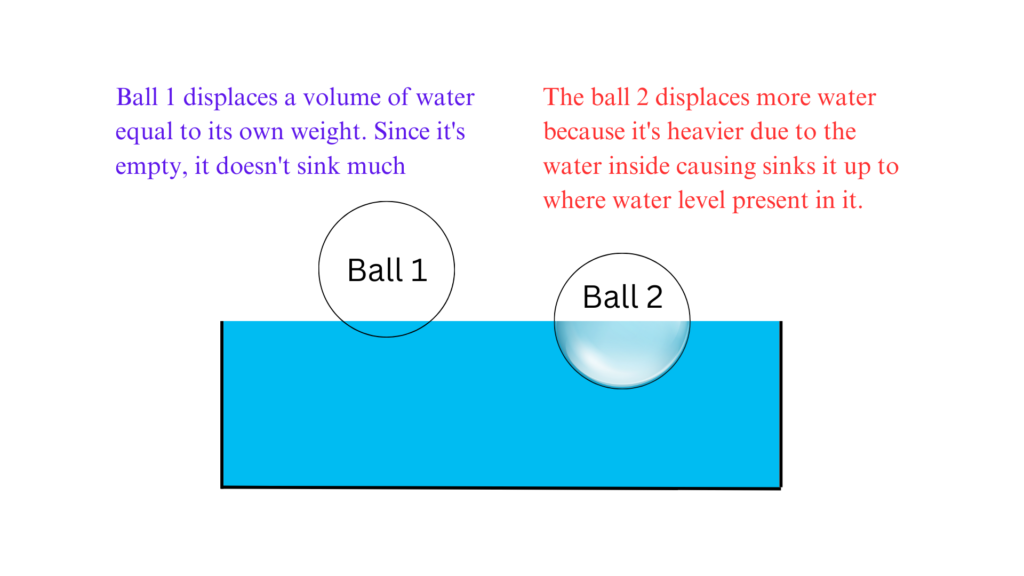
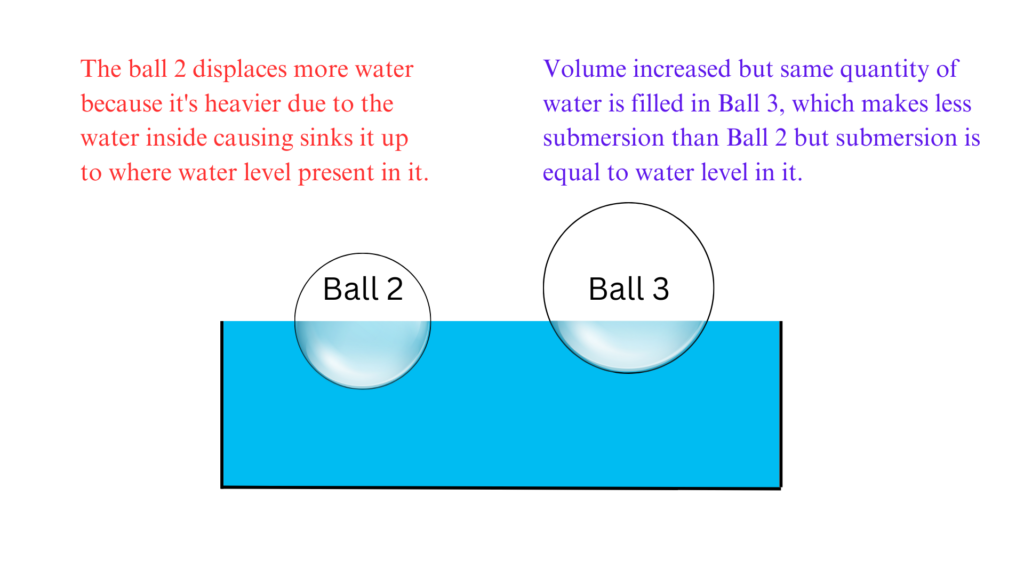
Now, take the second ball and fill it with some water and place it in the tub containing water. You’ll observe that this ball sinks deeper than the empty ball. The amount it sinks corresponds exactly to the volume of water it displaces. This illustrates that the volume of water (or the volume of the object filled with water) determines how deeply the object sinks in water.
Looking at another aspect, consider the size or volume of the balls. If you take a larger ball and fill it with the same amount of water as the smaller ball, you’ll notice that the larger ball sinks less into the water compared to the smaller ball. This is because the larger ball has a greater volume to displace the same amount of water, resulting in less submersion.
In summary, the sinking depth of an object in water is influenced by both its weight (or the weight of the material it contains) and its volume. Weight determines the amount of water displaced (buoyant force), while volume affects how much water the object can displace, thus affecting its buoyancy and sinking depth.
Buoyant force:
Let’s examine the buoyant force and how it acts on objects immersed in water.
Buoyant force is the upward force acting on objects submerged in a fluid, such as water. This force, which causes objects to float, results from the displacement of water. Archimedes explained this principle.
When a body is submerged in water, it displaces a volume of water equal to the submerged portion of the body. The displaced water exerts an upward force on the body, known as the buoyant force. The magnitude of this buoyant force is directly affected by the density of the objects involved.
Design Factor:
Now, let us discuss about design factor,
The shape of a ship’s hull is intended to maximize water displacement while preventing water inflow. This generates a buoyant force that is sufficient to sustain the weight of the ship.
construction materials:
Strong yet relatively light materials are used in ship construction, which contributes to the overall lower density.
Steel is used because it is robust but has been hollowed out to hold air, balancing buoyancy and strength.
Ballasting:
In submarines, ballast tanks located at either end are used to control the vessel’s depth in the water by adjusting its density relative to the surrounding water.
Ballast Tank Operation in Submarines
Filling the Ballast Tanks:
When ballast tanks are filled with water, the submarine’s overall density increases. As the submarine’s density becomes greater than the surrounding water, it sinks. This is due to the added weight of the water in the ballast tanks.
Emptying the Ballast Tanks:
When water is pumped out of the ballast tanks and replaced with air, the submarine’s overall density decreases. This makes the submarine less dense than the surrounding water, causing it to rise. The reduction in weight from expelling the water makes the submarine buoyant.
I hope this article helped to clear up your queries.
Just like a ballast tank stabilizes a ship, balance your ups and downs of life. Let go of the negatives and keep moving up in life.
EngineeringDude
Best of luck on your journey!
With love,
EngineeringDude.