


Definition:
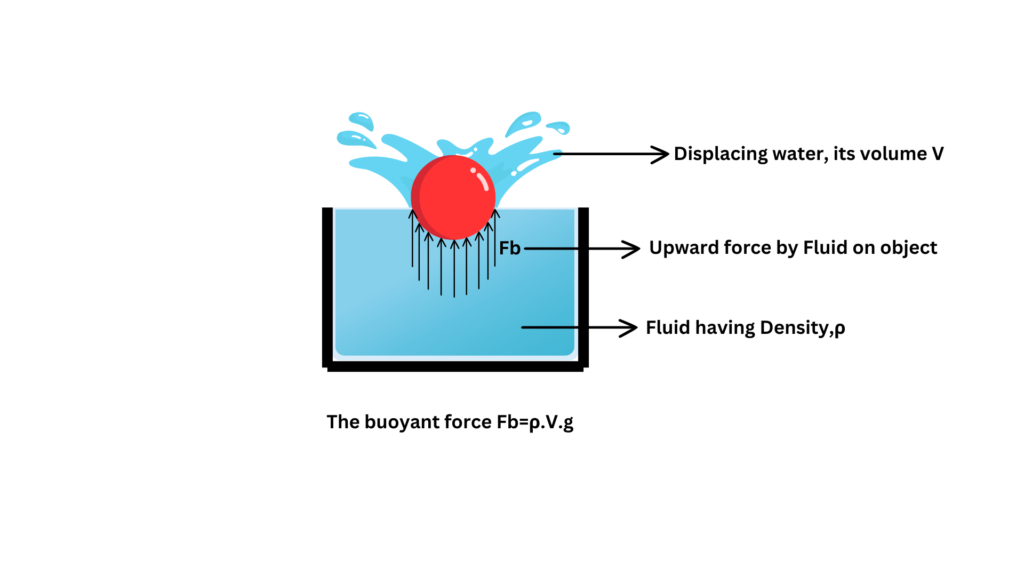
Buoyant force is the upward force exerted by a fluid on an object placed in it. This force is equal to the weight of the fluid displaced by the object. According to Archimedes’ principle, any object that is fully or partially immersed in a fluid, experiences a buoyant force equal to the weight of the fluid displaced by the object.
Archimedes’ Principle states that
Buoyant Force=Weight of Displaced Fluid
The buoyant force Fb can be calculated using the formula:
Fb =ρ.V.g
where:
ρ is the density of the fluid,
V is the volume of the fluid displaced,
g is the acceleration due to gravity.
Factors Affecting Buoyant Force:
Density of the Fluid: A denser fluid exerts a greater buoyant force.
Volume of the Displaced Fluid: A larger volume of displaced fluid results in a greater buoyant force.
Gravity: The acceleration due to gravity affects the magnitude of the buoyant force.
Applications:
- Ships and Submarines: They float or sink based on their buoyancy, which is managed by displacing water.
- Hot Air Balloons: They rise because the hot air inside the balloon is less dense than the cooler air outside.
- Hydrometers: Used to measure the density of liquids by floating at different levels depending on the liquid’s density.
Best of luck on your journey!
With love,
EngineeringDude.